The Life Scientific – Artificial Intelligence With Demis Hassabis

Google Subsidiary, DeepMind Software to Use Blockchain-related ...

Demis Hassabis, the brain and mastermind behind DeepMind technologies. An artificial intelligence (AI) company founded in the UK in 2010 and bought by google in 2014. Demis’s goal is to use AI to improve humanity. The first vision of DeepMind was to replicate human intelligence and have machines working with humans for a grand noble discovery.

Hassabis’s journey began as early as the age of 4 when he used to play chess and began to question his thought process during each game. After receiving his first computer at the age of 8, he began to read about computers and programming. “The chess computer hand book” by David Levy inspired Hassabis to combine his two passions, computers and chess, which led him to create his first computer program at the age of 12. At this point his love for computers and programming exceeded his love for chess.

Demis Hassabis - Wikipedia

After completing his A-levels at the age of 16, Hassabis was denied a place at Cambridge because of his age, in that time he gained experience in the workforce of programming and creating softwares. Once accepted to the University of Cambridge, Hassabis studied computer science and graduated with a double first-class honours degree at the age of 20. He then decided to pursue a pHD in neuroscience to understand how the brain works to replicate principles, operating systems and cognitive abilities to guide his research in artificial intelligence.

Demis Hassabis is truly an inspirational figure, his passion for computers, the brain and artificial intelligence fascinates me and inspires me to absorb as much knowledge as I could. Before listening to this podcast, I was already planning to go through a similar path to Demis, since I am a Psychology/Neuroscience student minoring in computer science. My own goal for the future was to combine these two forms of information and begin research in the healthcare industry, using AI as a tool for treatments and easing the lives of individuals who struggle with health problems.
Is your job at risk to computerization?

Have you noticed that machines have already started taking over our jobs?

If you haven’t, go to your nearest grocery store, do you see the self check out machine? if not, try going on the Bank of America app, all your transactions? automated. The calling center? automated. A Tesla car? automated!

How did all this happen you might ask? Artificial Intelligence. Artificial intelligence is a simulation of human intelligence in machines that are programmed to think like humans and mimic their tasks.

According to academics Micheal Osborne and Carl Frey at the University of Oxford “roughly 47% of job in the US are at risk for computerization”. The University of Oxford researchers evaluated and calculated how susceptible each job is to automation in a study conducted in 2013. The research was carried out by using data from the United states O*NET employment database.

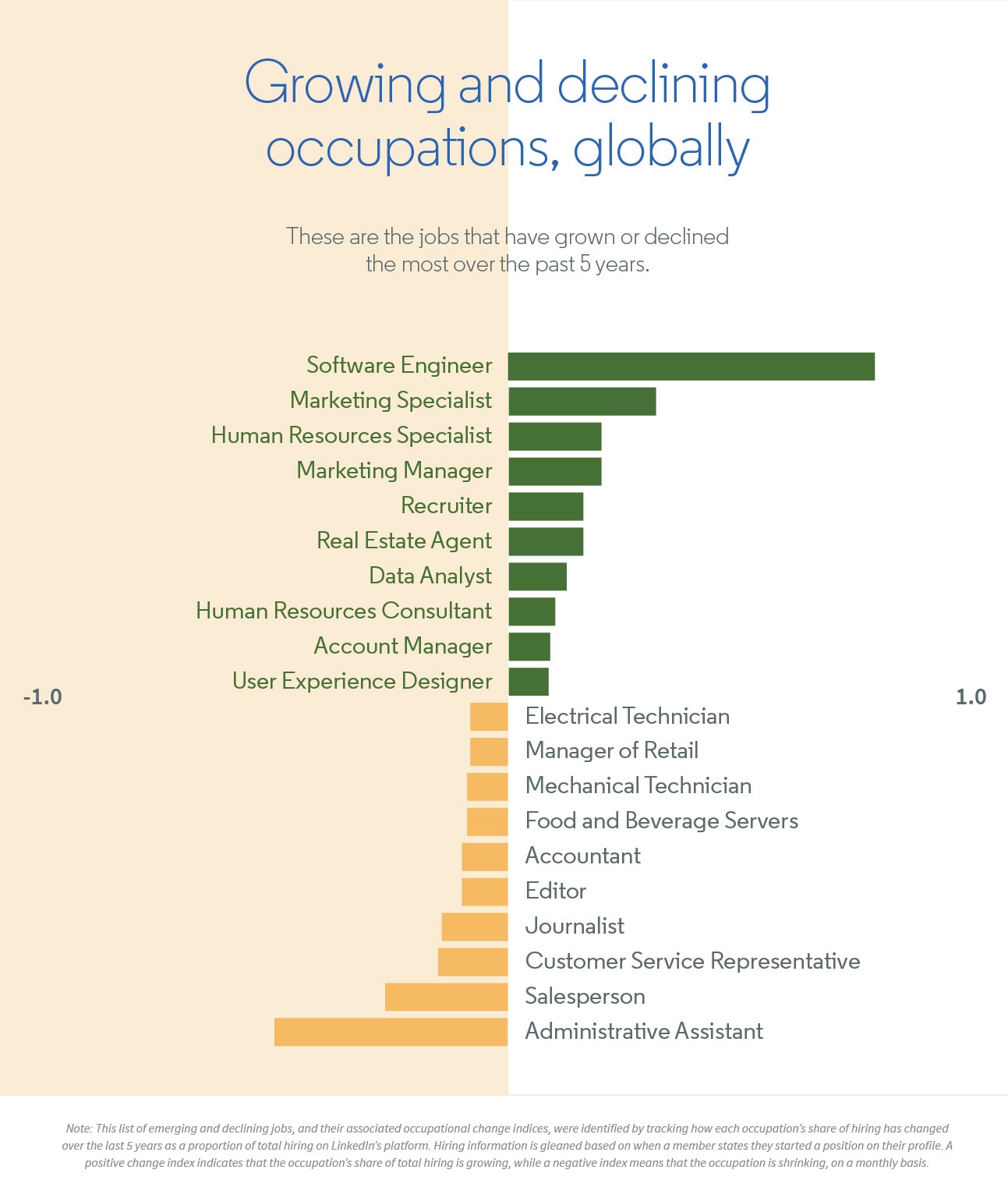
The following chart was taken from the World Economic Forum’s, where they discovered two current trends: the consistent increase of technological skills and occupations, as well as a growth in “human-centric” jobs that are dependent on human intelligence.

How could AI impact you?

As you can see form the chart above, jobs that require manual tasks have been declining and will continue to decline as time progresses. Therefore, if you are looking for an occupation or something to study it is essential to consider the future of that career before pursuing it.

New technology is being produced at a rapid pace, implying that there is always a possibility of change, it is better to be aware than unaware of what is best for your future.

If you are interested to learn more about AI and the future, click the following link:

All about me

Hello, My name is Afaf Sidani, and I am currently completing my B.S. in Psychology/Neuroscience with a minor in computer science at the University of Miami. Throughout my high school years, I always enjoyed the sciences, but I never thought I would be interested in the biological and psychological side of the brain until I wrote a research paper about it. Many people automatically assume that a Psychology/Neuroscience degree will result in a neuroscientist or doctor. However, I am planning to take a completely different route. The reason I combined a Psychology/Neuroscience degree with a minor in computer science is because of the similarities between the brain processes and modern technology. Artificial intelligence is the technological replica of the human brain, the CNS and its impulses, the machines are programmed to use artificial neural networks to react to stimuli and make decisions, just like the brain. In the future I plan to focus on the research part of neuroscience, where I will use AI to help people with brain disorders.

Design a site like this with WordPress.com
Get started